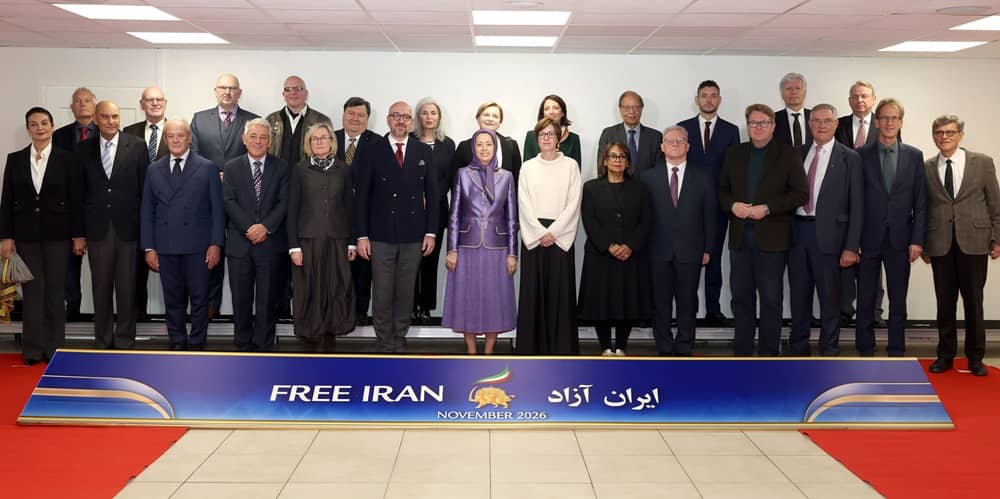
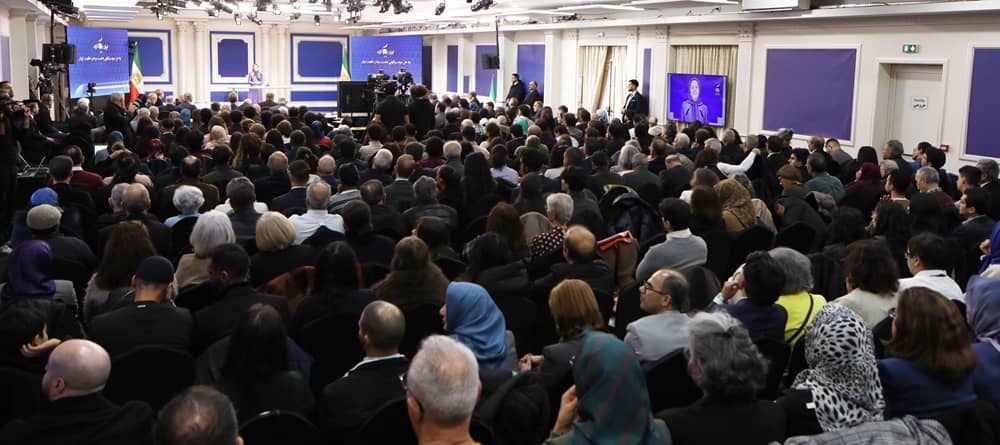
A Paris conference on Iran brought together former European leaders, British parliamentarians, and human rights advocates on Saturday, 21 November 2026, to examine Iran’s political future and European policy towards Tehran. Organised by the National Council of Resistance of Iran (NCRI), the event was titled “The Third Option: Overthrow by the Iranian People and Resistance” and marked the seventh anniversary of the November 2019 uprising. Speakers addressed executions, political imprisonment, women’s rights, and the role of young protesters and organised opposition groups. Several called for stronger European action on human rights and argued that political change should be led by Iranians, rather than imposed through foreign military intervention or prolonged diplomatic accommodation.
Maryam Rajavi, NCRI President-elect
Delivering the keynote address, Maryam Rajavi highlighted the role of young protesters and Resistance Units in Iran, arguing that intensified executions and repression reflected the authorities’ fear of renewed uprisings. She maintained that the solution lay “neither in appeasement nor in foreign war”, but in change driven by the Iranian people. She also called on European governments to condition relations with Tehran on an end to executions and the killing of protesters.
John Bercow, Former Speaker of the UK House of Commons
John Bercow criticised Western policies towards Iran and rejected both foreign military intervention and the restoration of monarchy. He argued that the current system “cannot be improved by appeasement or removed by war.” Challenging Reza Pahlavi’s claim to political leadership, Bercow emphasised that Iran’s future must be determined through democratic processes, highlighting freedom of expression, gender equality, and the abolition of capital punishment.
Baroness Verma, Member of the UK House of Lords
Baroness Verma called for stronger international accountability measures against Iranian officials, including the use of universal jurisdiction to pursue those responsible for serious human rights violations. She also urged governments to take action against overseas financial networks and assets associated with the Islamic Revolutionary Guard Corps (IRGC). Emphasising women’s leadership and democratic rights, she described the NCRI’s Ten-Point Plan as “modern, inclusive, and progressive.”
Lord Steve McCabe, Member of the UK House of Lords
Lord McCabe highlighted the case of Mohammad Javad Vafaei-Sani, the imprisoned Iranian boxing champion facing a death sentence who recently received a Magnitsky Human Rights Award. Calling for stronger political engagement with Iran’s opposition, he rejected both religious dictatorship and hereditary monarchy, insisting that the country’s future “must be the result of free and fair elections.” He also stressed that the Iranian Resistance was seeking international political support rather than foreign military intervention.
Charles Michel, Former President of the European Council
Charles Michel urged European and American leaders to reconsider their approach to Iran, arguing that years of negotiations and military confrontation had failed to deliver meaningful change. He called for democratic change led by Iranians themselves to become “the cornerstone of European policy.” Michel also criticised proposals to restore monarchy, emphasising that political legitimacy must come from the people through free elections rather than hereditary claims.
Anna Fotyga, Former Polish Foreign Minister
Drawing on Poland’s experience with the Solidarity movement, Anna Fotyga emphasised the importance of organised opposition and sustained international support in confronting authoritarian rule. She criticised past Western policies towards Tehran and argued that European governments should move beyond diplomatic condemnation. “We must be united,” she said, urging greater recognition of the organisation and determination of Iranians seeking democratic change.
Naike Gruppioni, Member of the Italian Parliament
Italian MP Naike Gruppioni focused on executions, political imprisonment, and the persecution of women in Iran. She called for concrete European measures to halt executions, secure the release of political prisoners, and pursue accountability for human rights violations. Addressing Iranian women, she described them as “protagonists in a battle for freedom”, emphasising that women’s full participation in political decision-making must be central to any democratic transition.
You can view a short synopsis of the conference below:
Other speakers included former German Defence Minister Franz Josef Jung; former European Parliament Vice-President Alejo Vidal-Quadras; former European Commissioner Mairead McGuinness; Lithuanian parliamentarian Emanuelis Zingeris; German Bundestag members Carsten Müller and Detlef Seif; former German ambassador Hans-Ulrich Seidt; former Norwegian minister Ola Elvestuen; and former European Parliament member Dorien Rookmaker.